Yes. We supply farms across most regions of Australia, from our base in Dorrigo, NSW and Central Coast, NSW. Made-to-Order Biofertiliser:Freight is quoted to your farm based on your location and order size. Because you’re shipping finished liquid, freight can be a big...
Allow approximately 2½ hours of hands-on labour per 1,000 L for batch preparation, decanting and clean-down. These are labour hours, rather than the elapsed fermentation time. Actual labour requirements vary with your setup and equipment. Explore DIY Biofertiliser...
Yes. SONIC Biofertilisers contain living microorganisms, and microbial activity gradually declines after production. For best results, use the product within three months of its production date. The best-before date is printed on every container. Freshness matters...
Biofertilisers generally work best applied at lower rates more often, rather than in one or two large applications. Regular applications keep feeding soil microbes through the season. Grazing pastures: Apply three or more times per year. Applying after grazing helps...
Yes. SONIC Biofertilisers can be applied through standard spray and irrigation equipment, including boom sprayers, airblast sprayers, tractor-mounted units, drones and fertigation systems. Mixing: Fill the tank with water first, then add the product to reduce foaming....
We service all regions across Australia for both product supply and on-farm production systems. Fresh processed biological fertilisers are delivered nationwide. For on-farm systems and training, we work with both local and remote operations. Where in-person visits...
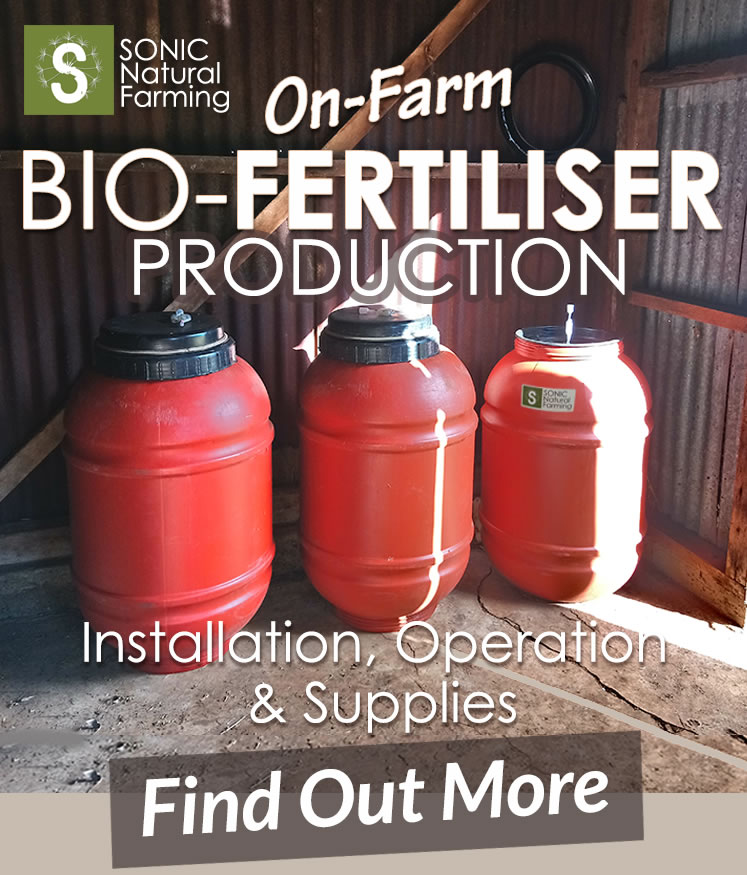
SONIC DIY Systems can be tailored to grazing properties, orchards, broadacre farms, market gardens and smaller mixed farms. The system is sized around how much liquid fish and seaweed biofertiliser your farm uses and when you need it. Your production and application...
The starter package covers your raw ingredients including Australian organic dried seaweed, Australian dried ocean fish (discards from processing), proprietary Starter Cultures, and supporting materials. Fermentation containers and equipment for decanting aren’t...
Producing biological fish and seaweed fertilisers on-farm can significantly reduce input costs through: Lower freight costs – Shipping dried raw ingredients instead of finished liquid products can substantially reduce freight costs. Actual savings depend on your...
It is a naturally cold-fermented liquid kelp supplement containing naturally occurring kelp compounds, such as alginates and fucoidans, along with minerals and the beneficial microbes produced during fermentation. This makes it a natural direct-fed microbial (DFM)....
Most farmers give it weekly or fortnightly at the standard dilution of 1:20 to 1:50, added to water troughs or feed. Frequency can be adjusted to suit your conditions: Regular use: Weekly or fortnightly, as an ongoing part of the diet.Higher-demand periods: During dry...
There are several ways to include it in your livestock’s diet: In drinking water: Add to water troughs at a dilution of 1:5 to 1:50.In feed: Add directly to feed, spray onto dry feed, or mix with grain.As a grain soak: Dilute and use to soak grain before feeding.In...
It is suitable for a wide range of farm animals, including cattle, sheep, goats, alpacas, horses, pigs and poultry. It can be used as a regular part of the diet, or during periods of higher nutritional demand, such as when feed quality is poor or around calving,...
SONIC Liquid Seaweed: no withholding period. SONIC Liquid Seaweed is plant-based and can be consumed by livestock, either while grazing treated pasture or added to drinking troughs. It is the base of the SONIC Liquid Seaweed Livestock Feed Supplement, providing...
Liquid seaweed extracts, such as Seasol, are usually produced using chemical or heat extraction to concentrate certain compounds. While these products are widely used, the process can reduce some of the natural components of the seaweed. Seaweed biofertiliser, on the...
Conventional synthetic fertilisers are designed to deliver nutrients rapidly, creating fast and predictable plant responses. When nitrogen, phosphorus, and potassium are applied in synthetic forms, plants often respond with quick greening and a surge in biomass....