
Australia has a diverse landscapes giving rise to a wide variety of soil types, each with unique challenges and requirements for optimal agricultural productivity. Understanding how to tailor organic fertilisers to the specific needs of your soil type is key to maximising crop yield and maintaining soil health.
Whether you’re managing nutrient-deficient sandy soils, handling the acidity of Podosols, or improving the structure of heavy clay Vertosols, choosing the right organic fertiliser is key. When used alongside regenerative farming practices, these fertilisers can have the best impact on soil health and long-term productivity. In this article, we explore the unique characteristics of Australia’s primary soil types and provide tailored organic fertiliser solutions that can address their specific challenges.
Soil Types Australia

Red and Yellow Soils (Ferrosols & Kandosols)
Description: Red and Yellow soil types are found in tropical and subtropical regions of Australia.
Challenges: Often acidic, with low organic matter, and can require amendments to improve pH and nutrient availability.
Solutions: For these acidic, low organic matter soils, to manage acidity, Lime helps neutralise pH levels, while Compost and Molasses add organic matter to improve soil structure and nutrient cycling. These fertilisers will help optimise soil fertility and make the land more productive. Liquid fish and seaweed fertilisers such as SONIC Liquid Fish™ and SONIC Liquid Seaweed™ are also ideal amendments, as they boost nutrient availability, enhance microbial activity, and support plant health.

Black Soils (Vertosols)
Description: Rich in clay, these soils are found in the inland regions of Australia and have high water retention.
Challenges: Black soil types (Vertosols) face challenges such as heavy compaction, poor drainage during wet periods, susceptibility to cracking, and difficulty in managing moisture and nutrient levels.
Solutions: Black soils are rich in clay, making them fertile but prone to waterlogging. SONIC Liquid Fish™ and SONIC Liquid Seaweed™ improve microbial activity and support soil fertility. To enhance drainage and prevent compaction, add Gypsum, Compost, and Biochar. These amendments improve soil structure, promote water infiltration, and prevent crust formation, ensuring the soil remains productive even in heavy clay conditions.

Loamy Soils (Chromosols)
Description: Chromosols (loamy soils) are fertile, well-draining soils found in Australia’s Murray-Darling Basin and southern regions.
Challenges: Chromosols may face challenges like occasional erosion, compaction, nutrient leaching, and waterlogging, especially in heavy rainfall areas or with improper management.
Solutions: Loamy soils are well-draining and fertile, but they can be prone to erosion. SONIC Liquid Fish™ and Compost enhance nutrient availability and stimulate root growth. Biochar helps improve soil structure, while Fulvic Acid increases nutrient uptake and enhances soil moisture retention. Using these fertilisers ensures loamy soils remain productive, healthy, and resistant to erosion.

Sandy Soils (Arenosols)
Description: Arenosols are found mostly around coastal areas in Australia.
Challenges: Sandy soils struggle with low nutrient retention, poor water-holding capacity, erosion risk, and fast drainage, making them challenging for plant growth and fertiliser efficiency.
Solutions: Sandy soils drain quickly and have low fertility, which makes them less ideal for retaining nutrients and moisture. To address these challenges, use SONIC Liquid Fish™, SONIC Liquid Seaweed™, and Compost to boost nutrient retention and improve soil structure. Fulvic Acid helps increase the soil’s ability to absorb nutrients, while Biochar enhances water retention, making sandy soils more fertile and easier to manage.

Acid Sulfate Soils
Description: This soil type is typically found in coastal lowlands in Australia.
Challenges: Acid sulfate soils pose challenges like soil acidity, toxic metal release, poor drainage, and nutrient imbalance, which can hinder plant growth and agricultural productivity.
Solutions: These soils are highly acidic and can release toxic elements when disturbed. To manage this, Lime is essential for buffering the acidity. Adding SONIC Liquid Fish™, SONIC Liquid Seaweed™, and Compost enhances nutrient uptake, promotes microbial life, and helps plants tolerate stress. These fertilisers support soil fertility while reducing the negative effects of high acidity, making the soil more productive.

Solodic Soils (Sodosols)
Description: Solodic soils are commonly found in inland Australia, particularly in parts of Queensland, New South Wales, and South Australia.
Challenges: Solodic soils have a high salinity and sodic nature, which affects soil structure and water infiltration. The high sodium content in these soils can lead to poor soil structure, making it difficult for plants to access nutrients.
Solutions: Solodic Soils are often affected by salinity and have high clay content. To address salinity and improve soil structure, use SONIC Liquid Fish™ and Compost to enhance microbial activity. Worm Juice and Lime can help with drainage and reduce salinity levels, while Fulvic Acid improves nutrient uptake and balances soil pH. These organic amendments improve the overall fertility and health of Solodic soils.

Acid Soils (Podosols)
Description: Common in Australia’s forested, coastal and mountainous regions.
Challenges: Acid soils, such as Podosols, are generally low in nutrients and have a naturally acidic pH. This makes them difficult for crops to access essential nutrients and can hinder microbial activity.
Solutions: Acid soils are low in nutrients and have poor water-holding capacity, making them less productive. To combat this, SONIC Liquid Fish™, Compost, and Humic Acid are beneficial. They help buffer acidity, enhance nutrient availability, and stimulate microbial activity. These organic fertilisers support healthier plant growth by improving soil structure and fertility.

Gypsisols
Description: Found in arid and semi-arid climates, often in areas like South Australia.
Challenges: Gypsisols are rich in gypsum. While gypsum can improve soil structure, these soils are prone to salinity and low organic matter. Effective management is needed to reduce salinity and improve nutrient availability.
Solutions: Gypsisols, rich in gypsum, are found in arid climates and are prone to salinity issues. Gypsum is key in improving soil structure and reducing salinity. Compost and Biochar help retain moisture and improve microbial activity. Adding SONIC Liquid Fish™ and SONIC Liquid Seaweed™ provides essential nutrients while helping crops manage plant stress, especially in dry conditions.

Regosols
Description: Young soils often found in river valleys or coastal plains in Australia.
Challenges: Regosols are young, immature soils, typically low in nutrients and poor in organic matter, making them less fertile for agriculture. These soils may also suffer from poor water retention.
Solutions: Regosols, found in river valleys and coastal plains, are low in organic content and fertility. To increase fertility and enhance microbial activity, use Compost, Molasses, and SONIC Liquid Fish™. These organic fertilisers improve soil structure, increase nutrient availability, and create a fertile environment for plant growth, transforming Regosols into productive land over time.
Disclaimer:
The information in this article is for general guidance and not professional advice—always consider your individual circumstances or consult with a professional before making decisions. For more details, please review our full Disclaimer.
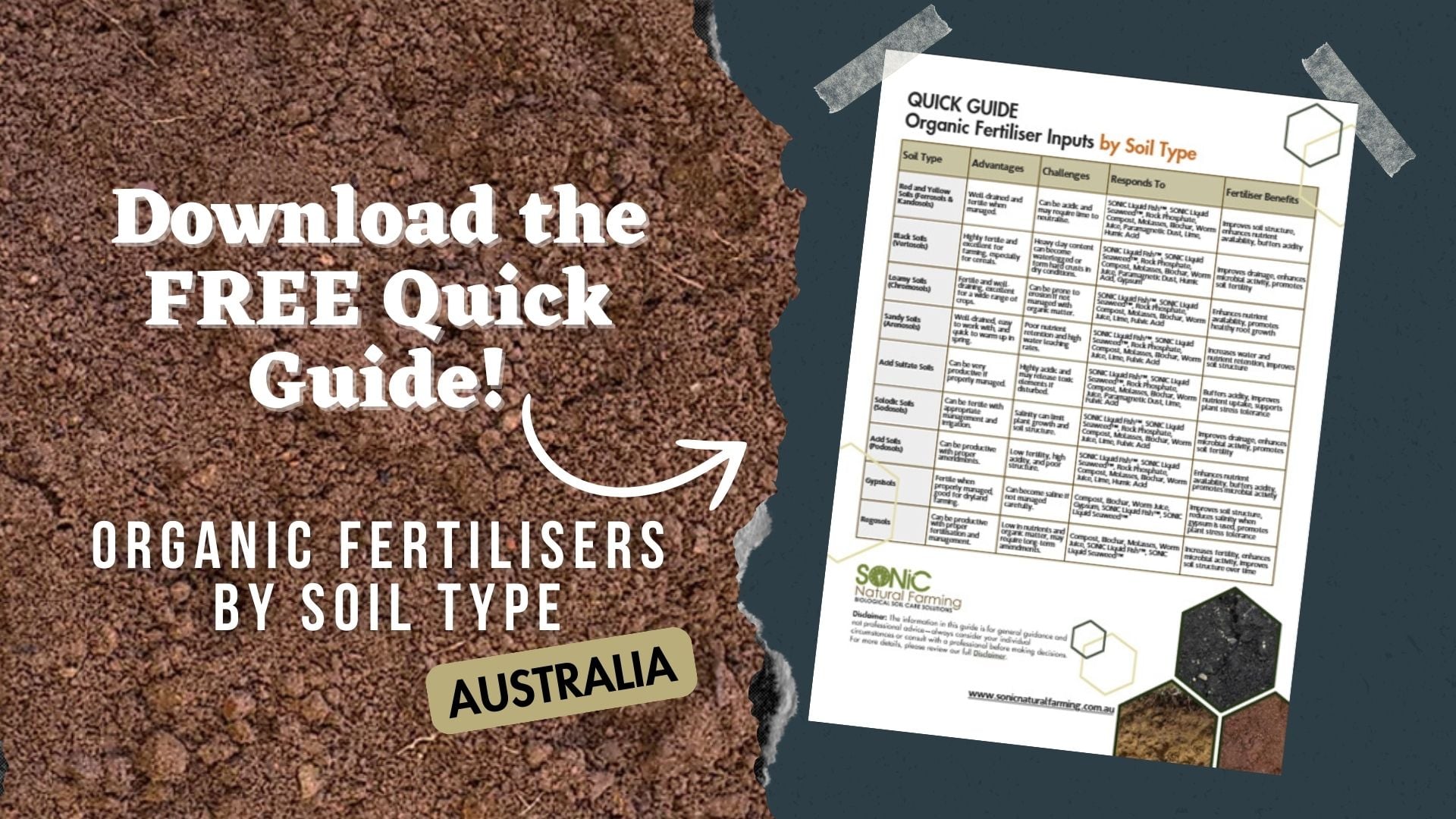
Unlock the potential of your land by tailoring organic fertilisers to suit your unique Aussie soil type. The right organic fertilisers—like compost, biochar, or liquid fish—can not only boost crop resilience, but also improve soil fertility and sustainability over time.
Discover some of the most popular natural organic fertilisers you can tailor to your soil. Download our ‘Organic Fertilisers by Soil Type – Quick Guide’ to get started!


Cut Fertiliser Costs By Up To 90%
You Might Also Like…
We are Australia’s leading provider of on-farm training for producing your own Biological Liquid Fish and Seaweed Fertilisers, supplying all raw ingredients and teaching safe, consistent cold-fermentation methods.