
Farmers in coastal regions around the world have fed seaweed to livestock for centuries, and kelp supplements remain popular with Australian farmers today, particularly as a natural source of iodine.
SONIC’s liquid kelp is made from bull kelp (Durvillaea potatorum), a large brown kelp found along Australia’s southern coastline and known for its iodine content and broad range of minerals and trace elements.
In this article, we look at what kelp provides, how fermentation changes it, and how to use it safely.

1. Kelp Is a Natural Source of Iodine and Trace Minerals
Kelp contains iodine along with a range of minerals and trace elements, including potassium, sodium, magnesium, calcium, zinc, copper and iron. It also contains amino acids and naturally occurring compounds such as alginates, fucoidans and polyphenols. Amounts vary with kelp species, season and harvest location.
Iodine is essential for thyroid function, which regulates metabolism and growth. Some Australian regions have soils and pastures that are naturally low in iodine, which is one reason kelp has remained a popular supplement here.
Kelp is best thought of as a mineral and trace element supplement. It complements a balanced diet rather than replacing other feed.
2.Why Trace Minerals Matter for Livestock
Minerals and trace elements play a role in growth, milk production, fertility and general body function. For example:
- Iodine is needed for thyroid function, metabolism and growth.
- Zinc is involved in skin, hoof and reproductive health.
- Copper is needed for red blood cell formation and coat pigmentation.
- Magnesium supports muscle and nerve function.
When pasture or feed is low in these, a mineral supplement can help fill the gaps.
3. Fermented Kelp: Probiotic Cultures in Liquid Form
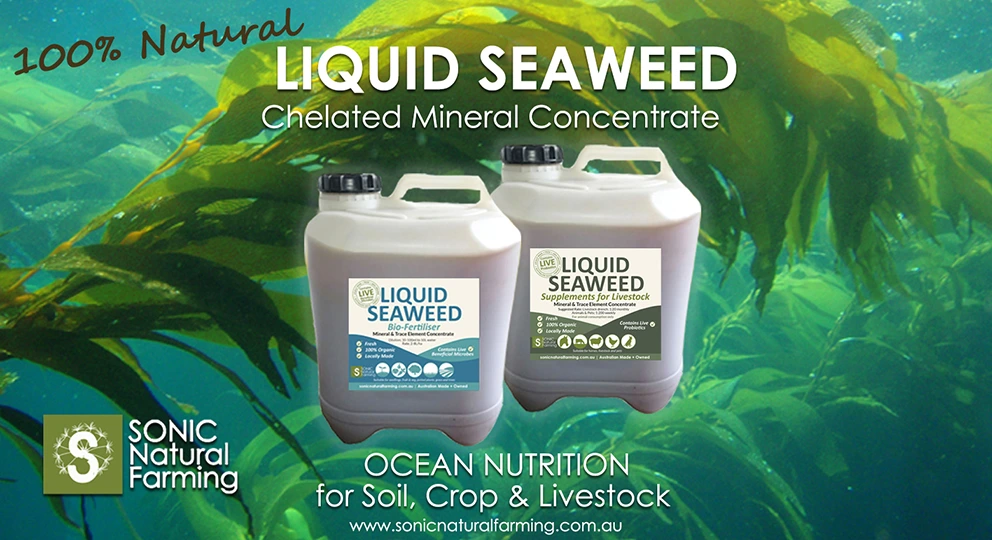
SONIC’s liquid kelp is cold-fermented with probiotic cultures. Fermentation turns the kelp into a liquid that mixes easily with water and feed, and the finished product contains the beneficial microbes produced during fermentation, making it a natural direct-fed microbial (DFM).
Kelp polysaccharides such as alginates and fucoidans are also being studied for their prebiotic properties, meaning their potential to feed beneficial gut bacteria.

4. Liquid Kelp vs Dried Kelp
Dried kelp meal is often offered free-choice or mixed into feed. But kelp has tough cell walls, made largely of alginates, and much of its mineral content is bound up inside them, which can make dried kelp harder for animals to break down.
During cold fermentation, the lactobacillus cultures help break down these cell walls, releasing minerals and other compounds into the liquid. This means they are already in solution when the animal consumes them, which may make them more readily available than minerals still bound in dried kelp.
Liquid kelp also offers some practical advantages:
- It can be added to water troughs, so every animal that drinks gets some.
- It mixes evenly into feed, grain or lick blocks.
- Dosing is easier to control with a dilution rate.
- There’s less dust and waste than with loose meal.
See our Rates and Methods page for suggested dilutions.
5. A Natural, Renewable Supplement
SONIC’s kelp is beach-cast, meaning it is collected only after it has naturally washed up on the shores of South Australia and Tasmania, rather than being harvested from living kelp beds. This means the kelp forests themselves are left undisturbed.
Kelp is also a fast-growing, renewable marine resource. SONIC’s liquid kelp contains no synthetic additives or preservatives, and the cold-fermentation process uses far less energy than heat or chemical extraction.
What’s In Kelp?
- Minerals and trace elements: iodine, potassium, sodium, magnesium, calcium, zinc, copper and iron.
- Natural compounds: alginates, fucoidans, laminarin and polyphenols.
- Amino acids: the building blocks of protein.
- From fermentation: probiotic lactobacillus cultures.
As a natural source of iodine and trace minerals, kelp remains a practical addition to many Australian livestock nutrition programs.
Disclaimer:
The information in this article is for general guidance and not professional advice—always consider your individual circumstances or consult with a professional before making decisions. For more details, please review our full Disclaimer.

We Show You How To Make Your Own Liquid Seaweed Livestock Supplement

LIQUID BIOLOGICAL SOLUTIONS
Ocean Mineral Nutrition
for Healthy Livestock