
57% of Australian farmers cite economic conditions as their biggest challenge —rising input costs, inflation, and unpredictable markets are tightening margins across the board. Fertiliser, fuel, feed, and labour expenses have all surged, forcing producers to rethink how they manage their budgets and business decisions.
In this article, we’ll explore practical, proven strategies to help you navigate these economic challenges, maintain cash flow, and keep your farm financially healthy through the seasons ahead and throughout 2026.

1. Cut Feed Costs Without Compromising on Livestock Health
Feed is one of the biggest expenses for livestock operations. But reducing feed quality or quantity can have long-term impacts on animal health and productivity. One practical way to support animals through tough feed seasons is to use a liquid seaweed feed additive.
This natural supplement supports mineral intake, hydration, and digestion — meaning your stock gets more out of every mouthful. It doesn’t replace feed, but it helps stretch feed further and can be added easily to troughs or dry feed.
How Liquid Seaweed Feed Additives Support Your Livestock
A liquid seaweed feed additive is a 100% natural supplement that offers multiple benefits for your livestock without replacing their regular feed. Here’s how it works:
1. Supports Mineral Intake
One of the key benefits of liquid seaweed (kelp) is its rich mineral content. Kelp is naturally high in essential minerals like calcium, magnesium, potassium, and trace elements like iodine and zinc, all of which are vital for your livestock’s health.
Many farm animals are deficient in these minerals, especially when they’re fed a limited or commercial feed that might not provide the full spectrum of organic nutrients they need.
By adding a liquid seaweed feed additive to your livestock’s diet, you can help fill these nutritional gaps, promoting better overall health and resilience.
2. Enhances Hydration
Another unique benefit of liquid seaweed is its ability to help with hydration, especially during the warmer months when dehydration can be a real concern.
Alginates, natural compounds found in seaweed (kelp), help bind with water in the animal’s digestive system. This means the water your animals do drink is utilised more effectively, helping to maintain proper hydration levels and prevent the negative effects of dehydration, like reduced feed intake, poor digestion, and decreased productivity.
3. Improves Digestion and Feed Efficiency
When livestock are well-hydrated and getting the minerals they need, their digestive systems function more efficiently.
SONIC Liquid Seaweed for Livestock also contains natural probiotics which help break down feed more effectively, allowing animals to extract more nutrients from the same amount of food. This means that even if you’re dealing with rising feed prices, the additive can help you get more out of your existing feed, ultimately stretching your feed budget further without sacrificing quality.
By improving digestion and nutrient absorption, seaweed also helps reduce the risk of digestive issues like bloating, colic, or poor weight gain, which can ultimately reduce your overall veterinary costs.
4. Easy to Administer and Cost-Effective
One of the biggest advantages of the liquid seaweed feed additive is its ease of use. You don’t need to invest in complicated equipment or systems. Simply add the supplement directly to the water trough, making it effortless for your livestock to consume. Because the additive is in liquid form, and it’s bioavailable, it’s easily absorbed by animals, and they’ll benefit from its hydration and mineral content fast.
This simplicity also makes it a cost-effective solution compared to other high-tech or expensive alternatives like specialised feed mixes or supplements. You can boost the health and productivity of your stock with a solution that’s both affordable and easy to implement.
Related article Tough Feed Season? Here’s How A Liquid Seaweed Feed Additive Can Help

2. Make Your Own Biofertilisers On-Farm
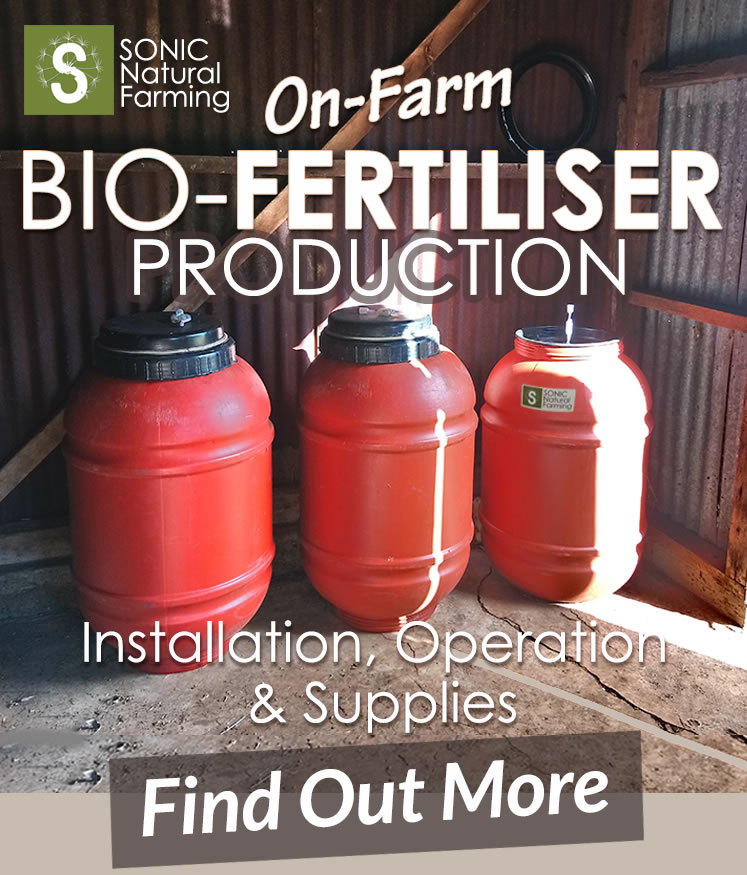
With the rising cost of commercial fertilisers, many Australian farmers are looking for ways to reduce their reliance on expensive inputs. Fortunately, it’s now possible to produce high-quality liquid biofertilisers on-farm using Australian sourced materials like seaweed and fish waste, all for under $1.20 per litre.
At Sonic Natural Farming, we provide Australian farmers with access the training, raw materials, and on-farm setups so they can easily get started with DIY biofertiliser production.
Liquid Seaweed Biofertiliser: Boosting Plant Health & Root Resilience
One of the most effective, and diverse, biofertilisers is liquid seaweed biofertiliser. Seaweed (especially kelp) is packed with essential minerals, trace elements, and natural growth hormones that can:
- Promote strong root development – Seaweed enhances root resilience, helping plants access water and nutrients more efficiently, particularly during dry spells.
- Improve plant stress resistance – Seaweed helps plants cope with environmental stresses like drought, pests, and diseases by improving their overall immune function.
- Enhance soil microbial life – The polysaccharides in seaweed feed beneficial soil microbes, helping to restore soil health and improve nutrient cycling.
Creating your own liquid seaweed biofertiliser allows you to harness these benefits without paying the premium prices of commercial products. This is where we come in, offering farmers the necessary training and raw ingredients to produce this ‘living’ biofertiliser efficiently on your own farm.
Fish Hydrolysate: Nitrogen, Microbial Life, and Overall Crop Vitality
Fish hydrolysate is another exceptional soil care solution. Rich in organic nitrogen, amino acids, and essential trace elements, it provides:
- Quick-release nitrogen – Fish hydrolysate delivers essential nitrogen that promotes healthy leaf and stem growth, contributing to plant vitality.
- Soil structure improvement – It helps to break down organic matter, improving soil texture and promoting water retention.
- Enhanced microbial diversity – The hydrolysate contains microorganisms that aid in soil health and nutrient cycling, crucial for a balanced and regenerative farming system.
With our support, you can easily create your own fish hydrolysate for a fraction of the cost of commercial alternatives and save big on shipping and container costs.
Training and On-Farm Setups: Start Making Your Own Biofertilisers
What makes our DIY Systems an invaluable resource for Australian farmers is the combination of hands-on training, raw materials, and on-farm setups that we provide. Here’s how they help farmers get started with DIY biofertiliser production:
- 1:1 On-Farm Training – easy-to-follow 1:1 training to teach farmers how to make their own liquid seaweed biofertiliser and fish hydrolysate. The training covers everything from scheduling through to the fermentation and decanting processes.
- Raw Materials Supply – We supply Australian sourced seaweed and fish, taking the hassle and guesswork out of sourcing these materials. We offer bulk purchasing options, allowing farmers to access the ingredients they need at a competitive price.
- On-Farm Setups – simple, scalable on-farm setups for producing biofertilisers, whether you have a small mixed farm or a larger operatio.. Our SONIC Systems can be tailored to your needs, ensuring that you can produce fertilisers in an efficient, cost-effective way that suits your farm’s size and goals.
By taking advantage of our resources, farmers can set up a production system with minimal investment and effort, empowering them to reduce their dependency on expensive synthetic fertilisers while creating a more sustainable farming operation.
Why DIY Biofertiliser a Game Changer for Australian Farmers
The ability to make your own biofertilisers gives farmers the power to:
- Reduce input costs – Seaweed and fish-based biofertilisers are much more affordable than commercial options, and making your own means you’re less exposed to price hikes.
- Reduce product shipping costs – Liquid fertilisers are heavy and the cost of shipping is going up, which makes on-farm production a cost-effective option.
- Reduce packaging costs – Single-use plastic is an environmental problem and an added expense, usually factored into the overall product cost. A DIY production system allows you to reuse all the fermentation and storage containers which helps the environment and your bottom line.
- Increase farm self-sufficiency – When you can produce your own fertilisers, you’re less reliant on external suppliers, making your farm more resilient to supply chain disruptions.
For mixed and regenerative farms, in particular, creating your own biofertilisers can provide a huge return on investment, both in terms of cost savings and the health of your crops and soil.
With our comprehensive training and on-farm setups, you’ll be equipped to start producing these vital inputs easily and efficiently, giving your farm a competitive edge as we move through 2026 and beyond.
Related Article Why DIY Biofertiliser Production is a Smart Investment for Your Farm

3. Use Water Smarter — Capture, Store & Reuse
Droughts may come and go, but water costs and shortages are always a concern. Investing in simple water-saving systems like:
- Gravity-fed irrigation
- Small-scale greywater reuse
- Portable troughs for efficient grazing rotation that can reduce pumping costs and waste, especially on hilly or remote blocks.
Related Articles Top 10 Strategies for Efficient Water Management on Australian Farms
4. Reduce Waste in Livestock Systems
Sometimes, saving money is less about adding something new and more about tightening the system:
- Use slow-feed hay nets or feeders to reduce spoilage
- Implement better pasture rotation to extend grazing days
- Repurpose on-farm waste (e.g., crop leftovers) into low-cost feed
These simple adjustments can make a surprising difference over a season.
5. Get Trained
Knowledge is one of the most underutilised tools in farming. Whether it’s learning how to make biofertiliser, read soil tests, or optimise rotational grazing — a few hours of training can result in years of savings.
Look for short workshops, community-led programs, or online resources that are practical and low-cost. Knowledge that helps you become less reliant on expensive inputs pays off quickly.
Contact SONIC Natural Farming for information about regenerative farming courses in your region.
6. Share Resources
The idea of collaborative farming is making a quiet comeback — not in formal co-ops, but in simple ways:
- Share large equipment (e.g., spreaders, mills)
- Bulk buy feed or inputs together
- Rotate paddock use or grazing with trust-based agreements
These kinds of informal systems can cut input and labour costs without needing major investments.
7. Revisit Your Farm Budget — With a Fresh Set of Eyes
Sometimes, the biggest cost leaks are the ones you’ve overlooked for years. Consider sitting down with a trusted advisor or peer farmer to go over your input spending line by line.
Look for:
- Subscriptions you no longer use
- Inputs that aren’t performing
- Cheaper alternatives with the same result
Fresh eyes can often spot what familiarity hides.
Conclusion – Small Shifts, Big Impact
No one solution will fix rising costs, but a combination of small, intentional changes can make your farm more resilient. Whether it’s making your own inputs, supporting animal health more efficiently, or just working a little smarter — these strategies can help take the pressure off without compromising your long-term success.
Farmers are some of the most adaptable, creative problem-solvers out there — and with the right support and ideas, 2026 can still be a year of growth and success, not just survival.
Disclaimer:
The information in this article is for general guidance and not professional advice—always consider your individual circumstances or consult with a professional before making decisions. For more details, please review our full Disclaimer.

Are You Still Buying Inputs You Could Be Making On Farm?