True soil fertility doesn’t come from synthetic fertilisers—it comes from how nutrients are cycled and made available through living soil biology.
Fertile soil is a living system. When that system is working properly, it can store, release, and cycle nutrients far more effectively than repeated applications of synthetic fertilisers.
What Is The Fastest Way To Improve Soil Health Naturally?
The fastest way is to combine organic inputs with biological stimulation. Applying biologically activated fertilisers, particularly fish and seaweed, can provide immediate bioavailable nutrients while also feeding and stimulating populations of beneficial soil microbes, helping to kickstart nutrient cycling and improve plant vitality.
Build The Biology First
At the centre of soil health is soil biology—bacteria, fungi, and other microorganisms that drive key processes such as nutrient cycling and form beneficial relationships with plants.
These beneficial microorganisms:
- Break down crop residues and organic matter
- Unlock nutrients already present in the soil
- Supply nutrition to plants in a steady way
Rather than pushing rapid growth through synthetic inputs, a biologically active soil supports more balanced, resilient production.
Feed The Soil, Not Just The Crop
Long-term soil health comes from building a base, not just short-term responses.
Key practices for building soil health include:
- Returning organic matter to the soil
- Maintaining living ground cover where possible
- Using crop rotations or pastures to build carbon and nitrogen
- Encouraging plant diversity
- Minimising unnecessary soil disturbance
These practices are regenerative and create a reserve of nutrients held in organic forms, which are less prone to leaching and better aligned with plant demand.
How Do Biological Fertilisers Activate Soil Biology?
Biological fertilisers are not designed to replace nutrients with another quick input. Instead, their role is to help restore function in the soil.
In practical terms, biological fertilisers:
- Introduce and stimulate beneficial microbes
- Support the breakdown of organic materials
- Help convert existing nutrients into plant-available forms
For broadacre and pasture systems, this approach can reduce reliance on repeated synthetic applications over time, as the microbial networks in the soil begin to do more of the work.
Focus On Nutrient Cycling
In conventional systems, crop growth primarily depends on continual input. In a biological system, the focus shifts to nutrient cycling.
Biologically active soil:
- Stores organic matter and microbial biomass
- Releases nutrients gradually through biological activity
- Retains more nutrients effectively in the root zone
This can improve efficiency, particularly in Australian conditions where losses from leaching, volatilisation, and runoff can be significant.
| Category | Conventional Systems/Synthetic Fertilisers | Regenerative Systems/Biological Fertilisers |
|---|---|---|
| Main focus | Directly feeding the plant. | Building soil function and nutrient cycling. |
| Fertiliser Source | Manufactured from synthetic chemicals or mined minerals. | Derived from natural materials like fish byproducts, compost, or seaweed. |
| Fertiliser type | Synthetic NPK, urea, soluble nutrients. Primarily provides specific nutrients like NPK in concentrated forms. | Biological fertilisers (e.g. liquid fish fertiliser, seaweed biological fertiliser) contain a broad spectrum of balanced nutrients and microbes. |
| Nutrient delivery | Quick-release, providing immediate nutrients to plants but often lacking sustained availability. | Varies by application: Quick-release when used as a foliar spray (absorbed through leaves); slow-release when applied to soil, feeding plants over time via microbial activity. |
| Plant growth | May stimulate rapid plant growth but can cause nutrient imbalances, and does not on its own ensure nutrient-dense crops. | Supports balanced, resilient growth with improved flavour and nutrition; helps achieve higher nutrient density in crops. |
| Role of soil biology | Important but indirect role, often constrained by management practices. | Actively supported as the driver of nutrient cycling. |
| Soil structure impact | Can decline if organic matter is not maintained. | Improved through organic inputs and biological stimulation. |
| Application Frequency | Frequent applications required to sustain growth; dependence increases over time. | Initially applied more frequently to activate soil biology, then less often as natural ecosystems restore balance and fertility. |
| System dependency | Ongoing reliance on repeated fertiliser applications. | Reduced dependency as soil function improves. |
| Response time | Fast, immediate nutrient uptake. | Balanced response: immediate nutrition plus longer-term soil improvement. |
| Long-term trend | Maintains production through continuous inputs. | Builds resilience and self-sustaining soil function over time. |
See Soil Biology in Action: Troy’s Regenerative Farming Journey
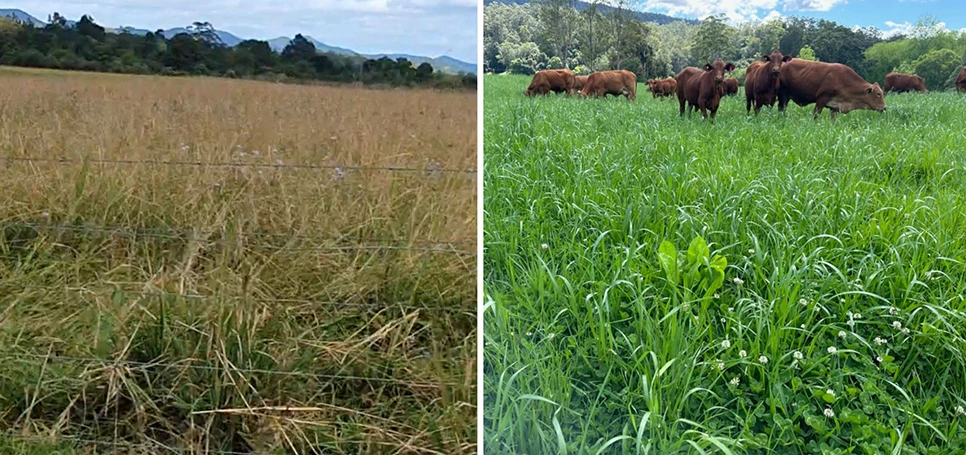
The principles of building soil biology are best understood by seeing them in practice. In our Australian Farmer Journeys series, Victorian beef producer Troy shares his transition away from a conventional, synthetic-input system towards a regenerative approach focused on improving soil health from the ground up.
Over several years, Troy implemented biological fertilisers and regenerative management practices to stimulate soil biology, improve nutrient cycling and build healthier, more resilient pastures. His journey offers an honest look at the challenges, observations and long-term outcomes of adopting a biology-first approach, demonstrating how healthier soils can support more productive farming systems over time.
The Bottom Line
Increasing soil fertility without synthetic fertiliser is not about doing less—it’s about getting more out of the soil you already have.
By rebuilding biological activity and improving nutrient cycling, farmers can develop soils that are more productive, more resilient, and less dependent on external inputs over time.
Biological fertilisers play a key role in this process by helping to restore the natural systems that drive fertility at scale.
Related Videos
Recommended Viewing
Disclaimer:
The information in this article is for general guidance and not professional advice—always consider your individual circumstances or consult with a professional before making decisions. For more details, please review our full Disclaimer.

Stress Less and Lower Your Input Costs From Season To Season